What did GHK-Cu change in repair studies?
The strongest finding comes first. Every note names what got the GHK: people, animals or lab-grown cells.
How GHK-Cu works on two fronts in lab tests
In lab tests, GHK-Cu worked two ways at once.
First, it acted as a delivery truck for copper. Some of the body's repair proteins need copper to work. One of them ties collagen and elastin fibers together [6][7]. GHK stripped of its copper didn't raise MMP-2, an enzyme that clears away worn collagen [6].
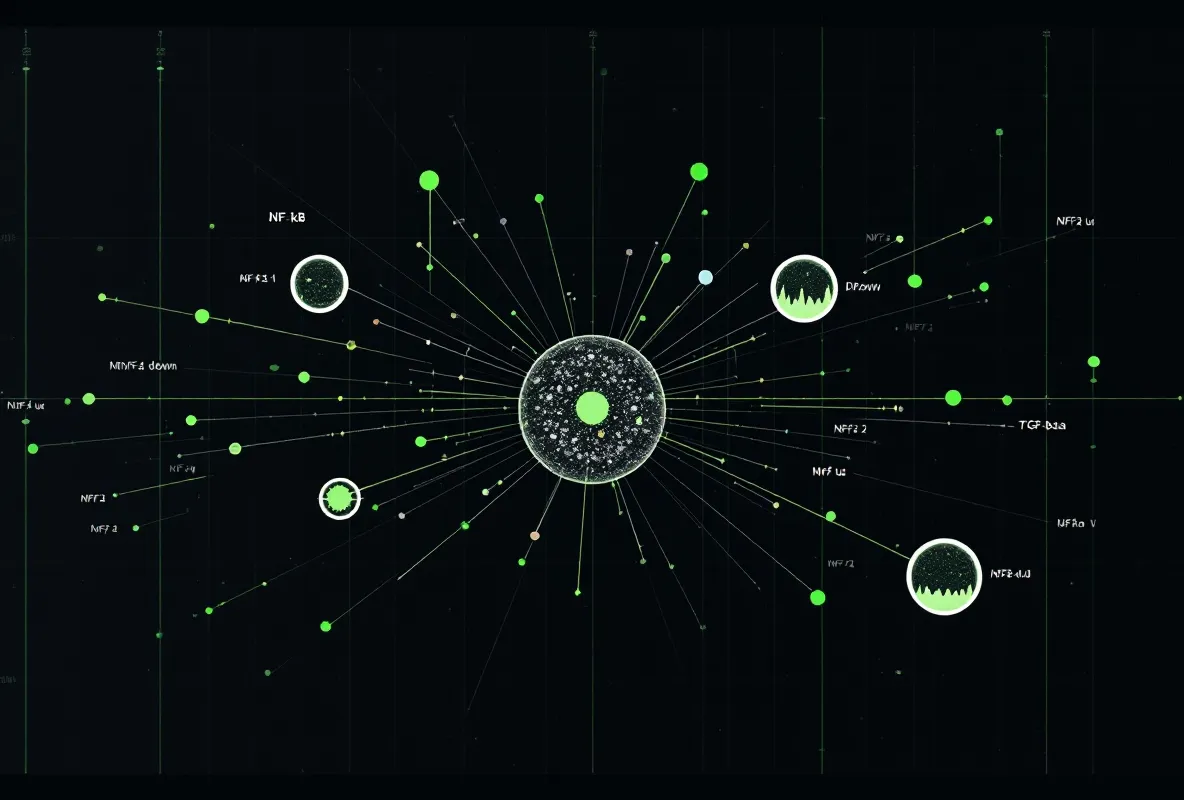
Second, it seemed to change which genes were busy. A computer search of earlier lab results on human cells did the looking. It found GHK nudging many genes up or down by at least half. The cell's trash-disposal system stood out. It breaks down worn-out proteins inside the cell. Of its genes, 41 went up and 1 went down [2].
The effect on scarring depended on the wound. In fresh wounds, GHK helped rebuilding. Where scarring ran wild, it held scarring back [2][8]. It also kept two collagen-cutting enzymes, MMP-2 and MMP-9, in step with their brakes. The body's brakes on them are TIMP-1 and TIMP-2. That balance lets old tissue get cleared without new tissue being eaten away [3][6].
None of this shows GHK-Cu heals a person. Read any big claim you meet with that gap in view.
What GHK-Cu did to swelling in mice and lab dishes
The clearest animal result came from mice with scarred lungs. They got GHK as shots into the belly every other day. The liquid came in three strengths: 2.6, 26 or 260 micrograms per milliliter. A microgram is a millionth of a gram. Stronger doses cut the scarring and extra collagen more. They also cut IL-6, a chemical the body puts out when tissue is swollen [8].
A second team used mice with sore colons. The mice got 20 milligrams of GHK-Cu per kilo of body weight, by mouth. They looked less sick. ZO-1, a protein that seals the gaps in the gut lining, went up. IL-6 went down [14].
In dishes, loose copper damages the cholesterol carried in blood. GHK-Cu stopped that fully, while a protective enzyme the body makes itself blocked only about 20%. GHK-Cu also cut iron leaking out of ferritin, the body's iron-storage protein, by 87% [7].
A separate team tested lung cells taken from emphysema patients. Emphysema is the lung disease that wrecks the air sacs. The dish held GHK at 10 nanomolar, a few millionths of a gram per liter. Genes gone wrong in the sick cells moved back toward normal. So did integrin beta-1, a protein cells use to grip what's around them. The cells pulled on collagen the way healthy lung cells do [9].
You won't find a person in any of these tests.
What GHK-Cu changed in healing wounds
A long review pulled together many wound studies. In wounds treated with GHK-Cu, collagen rose, and so did elastin, the stretchy protein. They made more FGF-2, a body chemical that tells new blood vessels and skin cells to grow. Two proteins that help nerves grow, neurotrophins 3 and 4, went up. TGF-beta-1, a chemical that drives thick scarring, went down. Repair cells were drawn into the wound [6].
So GHK-Cu touched many parts of healing at once, not just one.
Another team built a collagen pad that held GHK right at the wound. Rat skin wounds healed faster under it [12]. No person was tested with that pad, so it tells you nothing yet about human skin.
What GHK did to genes, brain cells and rat behavior
The gene finding came from a computer, not from treating anyone. Researchers searched a big library of earlier results on human cells grown in labs. GHK seemed to turn a large share of human genes higher or lower [2].
You'll often see this quoted as about 4,000 genes. That figure was stretched from the data. The paper's own table of genes that moved by 50% or more lists closer to 2,100. The smaller number is the one the table backs. Either way, animals or people still need to confirm it [2].
The brain work is at an early stage. In lab-grown brain cells, copper and zinc made proteins clump and cells die. GHK stopped both by grabbing the loose metal [15].
In rats, GHK and close cousins of it made the animals act less anxious [10]. In another rat study, it cut down the biting and fighting that pain had set off [11]. No study has tested GHK on a human brain, so none of it speaks to yours.
Does GHK-Cu calm swelling?
In sick mice, yes. GHK lowered IL-6, a chemical made in swollen tissue. In mice with scarred lungs, belly shots cut IL-6 and scarring, and bigger doses did more [8]. Mice with sore colons got 20 milligrams per kilogram they weighed, by mouth. Their IL-6 fell too [14]. No people took part, and animal doses aren't meant for you.
What do GHK-Cu studies say about aging?
Not much that applies to you yet. Blood carries less GHK with age. At age 20, each milliliter holds about 200 billionths of a gram; by age 60, about 80 billionths. A computer search found GHK shifting many genes by 50% or more, mostly toward repair [2][3]. The only human tests were small skin-cream studies. None of it tells you how you'll age.

How GHK-Cu differs from GHK without copper
GHK on its own carries no copper. GHK-Cu carries one speck of it. Chemists weigh and register them as two separate substances [6]. The difference shows up in results. Only the copper form raised MMP-2 in skin cells, the enzyme that clears worn collagen [6]. Plenty of gene studies worked with plain GHK. Before you lean on a paper, see which form it tested.
Does GHK-Cu speed wound healing?
In rats and lab tests, wounds closed faster. Treated wounds built more collagen and elastin. FGF-2, a growth chemical, went up, and more repair cells arrived [6]. TGF-beta-1, a chemical behind heavy scarring, went down. Rat skin wounds healed sooner under a collagen pad that held GHK [12]. Shots haven't had a fair trial in people. Rat skin can't settle your care.
Which genes did GHK-Cu seem to switch?
The answer comes from a computer search, not from treating anyone. Scientists checked GHK against a library of earlier lab results on human cells. Among genes that moved by 50% or more, 59% went up and 41% went down. The cell's trash-disposal genes, which clear out worn proteins, stood out: 41 up and 1 down. Genes for repair and for shielding cells moved too [2]. Nobody has checked those changes in living animals or people yet.
Does GHK-Cu protect brain cells?
Only in a dish so far. Copper and zinc made proteins clump in lab-grown brain cells, and the cells died. GHK soaked up the loose metal and stopped both [15]. In rats, it eased anxious behavior [10] and cut fighting set off by pain [11]. No study has tried it on your brain or anyone else's.