What changed when skin studies used GHK-Cu?
Small studies found firmer skin and shallower wrinkles. Lab dishes suggest why, but skin keeps most GHK-Cu out.
What copper peptide skin research found first
It began in a lab dish of skin cells taken from people. With GHK-Cu added, they made more collagen, and they did it without multiplying [1]. The amounts were tiny. Collagen started rising somewhere between 10 to the minus 12 and 10 to the minus 11. It rose most near 10 to the minus 9. In everyday terms, that's a trillionth up to a billionth of a standard lab strength.
GHK-Cu also got the cells making other parts of the skin's padding, not only collagen. One part holds moisture. Another helps collagen fibers lie neatly in order [3].
Only small groups of people took part in the human tests. Each face cream or serum was set against a placebo. That's a dummy product that looks the same but holds nothing active. A serum is a light, watery skin product. Skin got firmer and clearer. Fine lines softened, and wrinkles grew shallower [3]. A 2025 review found the same thing. It also named the main snag. Plain GHK dissolves in water, not oil, so it struggles to get through the skin's oily outer layer [13].
The amounts used in these studies show what each test used. They aren't instructions for you.
What GHK-Cu held back in skin cells
In lab work, GHK-Cu also held back things that wear skin down. It lowered TGF-beta-1, a body chemical that pushes tissue toward scarring. It cut cell damage caused by oxygen. It cut sugar damage, where sugar sticks to proteins and stiffens them. And it calmed signs of swelling [6][7].
In a dish, loose copper damaged the cholesterol that travels in blood. GHK-Cu stopped that fully. It also cut the iron leaking out of ferritin, the body's iron-storage protein, by 87% [7]. Loose iron can damage cells, so less leaking means less harm. These were dish tests, not heart tests in people.
Copper also feeds the protein that ties new collagen and elastin fibers together. So in skin, GHK-Cu may do two jobs: help build the support, and help protect it [6][7]. Small skin studies found firmer skin with less deep wrinkles [3][13].
The animal swelling studies are on the research page. Your skin could still act another way.
How much GHK-Cu gets through the skin
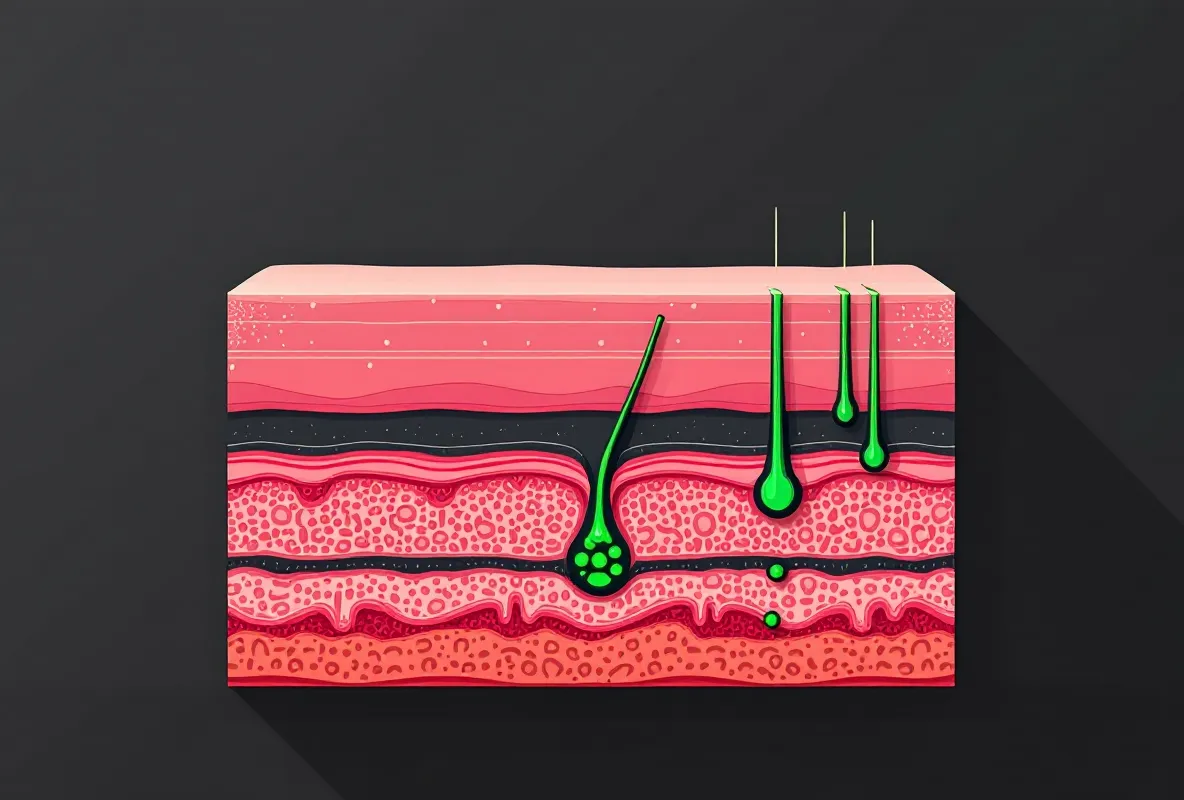
Very little, unless someone helps it along. Plain GHK has trouble getting through unbroken skin [13]. A lab test on pieces of human skin found the copper form did get through, slowly.
The paper gives the rate as 2.43 times 10 to the minus 4 centimeters per hour. That means a slow seep. Over 48 hours, 136.2 micrograms per cm^2 of copper went all the way through. Each of those squares is a square centimeter, about the size of a fingernail. A microgram is a millionth of a gram. Another 97 micrograms per cm^2 stayed inside the skin, like a small store [5].
To get more in, researchers joined a fatty tail to GHK. They wrapped it in tiny fat bubbles. And they pricked the skin first with fine needles. With the needles, about 134 nanomoles of GHK got through. That's still well under a thousandth of a gram. Through unbroken skin, none did [13].
The review calls these methods early, not proven [13]. How much would pass through your skin isn't known.
What can break GHK-Cu or upset your skin
Harsh products and skin procedures, mostly. Vitamin C serums that are very acidic, below about pH 3.5, can knock the copper loose from GHK. The pH number is a scale for acid: the lower it goes, the stronger the acid. Acid peels can do the same, and the broken mix may sting [13]. The copper stayed attached best between pH 5-6.5, which is only mildly acidic [6][13].
Reactions stayed on the skin where the product went. In one acne-scar study, researchers pricked the skin with fine needles and put on a copper peptide. About 40% of people got dark patches. Needles and copper were used together, so that study can't say which one caused them. In another study, 13 people used a copper cream after laser treatment. Their skin showed no measured gain over the others, though they liked the copper cream better [13].
So the product and the procedure both change the result. Your own skin could go either way.
What might GHK-Cu change in your skin?
Mainly how much collagen it makes. In dishes, GHK-Cu got skin cells making more collagen [3]. In small trials, 70% of women using GHK-Cu showed more collagen. With vitamin C it was 50%, and with a vitamin A cream 40% [3][13]. Those were small groups. They can't promise your skin the same.
Did GHK-Cu raise collagen in skin cells?
Yes, in a dish. Collagen started rising at amounts written as 10 to the minus 12 and 10 to the minus 11. It peaked near 10 to the minus 9. Each is a billionth or less of a lab strength. There were no extra cells; each made more [1]. Small trials on people's faces reported denser skin too [3]. Your skin isn't a dish, though.
How long before skin changed in GHK-Cu studies?
Weeks to months. Skin got firmer and wrinkles got shallower over courses of several weeks to several months [3]. Each study used its own product and its own length. No single wait has been proven, and you may see no change at all.
Is GHK-Cu better than retinol, a vitamin A cream?
Not in any simple way. One review counted collagen gains. They came in 70% of people on GHK-Cu, 40% on a strong vitamin A cream and 50% on vitamin C [3][13]. The two creams work differently, and GHK-Cu tends to sting less. Researchers treat them as partners, not rivals. One small comparison can't pick your product.